


Have you ever wondered why receiving feedback feels so dreadful? It’s probably because most people are terrible at giving constructive feedback. Instead, they give useless, lazy, or even hurtful “feedback”. I wasn’t surprised to read about the massive disproportion of bad feedback given to women compared to men. In my experience, the large and historical unbalance between women and men in tech jobs perpetuates that dynamic, to the point where 50% of women leave the Tech industry before the age of 35.
I grew up in France, where the educational system is much harsher than the American one in its grading and feedback system. Then, I went to graduate school, which is renowned for its ruthless feedback. By the end of it, my ego had been grinded into a fine powder, but I gained the very valuable ability to recognize good from bad feedback.
In this Part II of Seafaring for Women in Software Engineering, I share what advice I have accumulated, and direct it to young and younger women in software engineering in individual contributor roles. I hope that by sharing, I might help some of you stay a little longer and even thrive!
There is always a relevant PhD Comics!
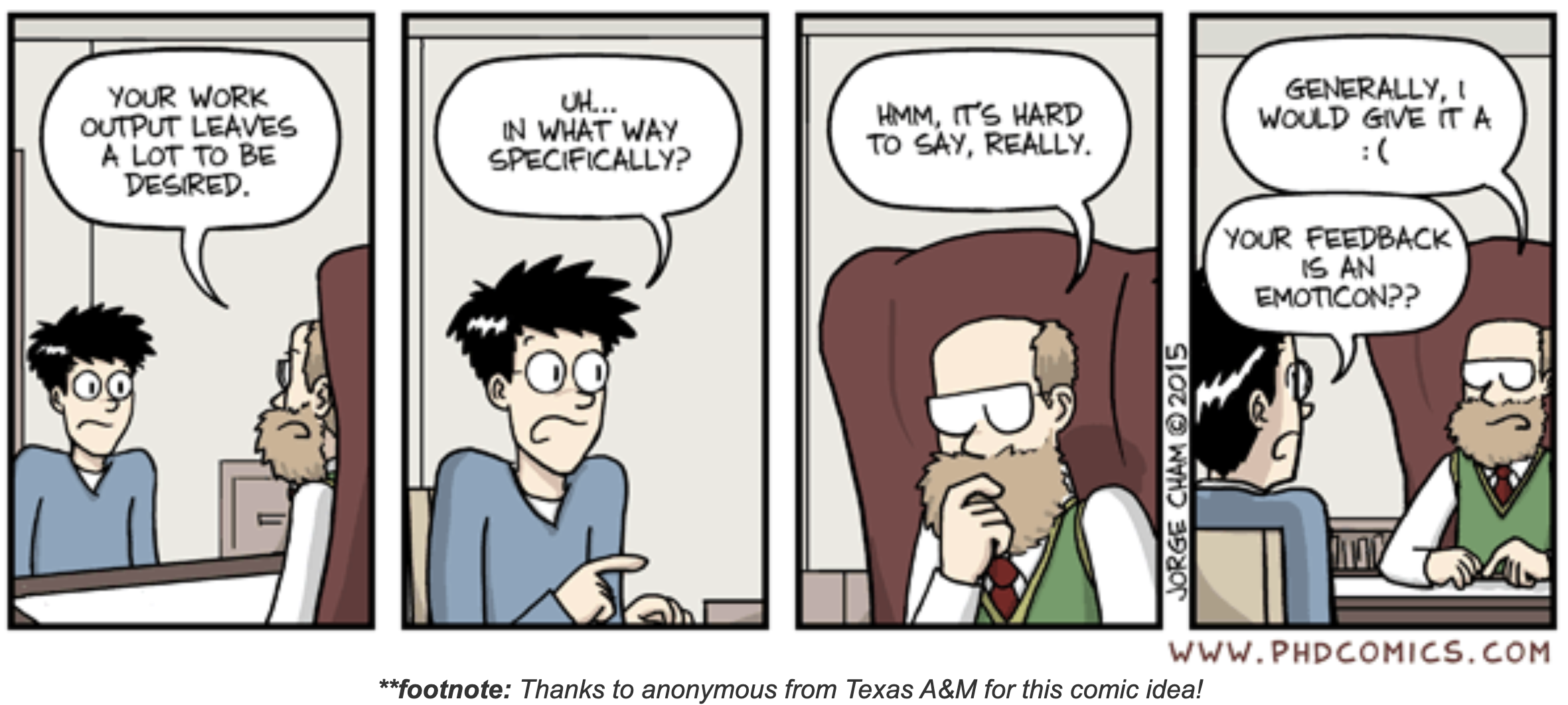
The Good, the Bad, and the Ugly Feedback
Take What You Need and Leave the Rest
In general, “feedback” is a euphemism used in the North American corporate world to describe what people thought about what you could have done better. It can be extremely subjective.
Ideally, feedback should be the basis for improvement. Good feedback is constructive and actionable. It is given gracefully, with the person’s best interest and possible progression in mind.
Why is good feedback so rare if it is so easily identifiable?
- People are terrible at formulating feedback constructively, no matter their intent. It is a learned skill to be able to express how a person should change/work/perform without being destructive.
- Not everything is actionable. You might not have control over what needs to be adjusted.
- Some constructive and actionable steps may be beneficial for your career, but not always.
Remember, you are the captain!
From “Defend” to “Harvest”
With good feedback being so rare, it is likely that instead, you will receive “ugly” feedback. Ugly feedback is something that may be relevant to improve, but the delivery of it caused you discomfort at best, and a knee-jerk reaction at worst. It’s natural to have defensive reactions to ugly feedback, and to focus on the form rather than the content. My instinctive response is always a combative one. But I have found that reframing my mindset to focus on the content rather than the form helped me learn something from the ugly feedback. Don’t defend, harvest. Ask yourself: “What is the relevant part?”, “What can I learn from this?”
Ignore it.
There is no escaping it. You will receive feedback that you find unfair, unjust, insulting, all the way down to the many-ist. Bad feedback is destructive, unactionable, and truly unusable. Ignore it. But how do you recognize it from the ugly?
As you gain experience, grow into new roles, and meet more and more people, you will start noticing a pattern in the feedback you get:
- The legitimate areas of improvement, which ebb and flow as you work through them.
- The lazy feedback that relies on some stereotypical aspect of your personality, communication style, or working/thinking pattern.
Bad feedback is lazy feedback. For instance, it is incredibly lazy feedback to say to an outspoken woman that she lacks “restraint” (actual quote). It is lazy to say to a reserved woman that she is too quiet or too shy.
There is nothing to harvest from someone pointing at a personality trait and imposing a stereotypical prejudice on top of it. It is incredibly destructive. If a particular behavior is truly impacting your performance, then good feedback should include concrete techniques that bridge the perceived gap. For instance, “I’d like us to focus on your input during meeting by doing X,Y and Z.” In the meanwhile, dear managers, have mercy on my soul and don’t say to “shy women” to “speak more”, or “outspoken women” to “have restraint”, especially if none of your male employees receive similar feedback. (I know they don’t. I asked.)
In my experience, lazy feedback has more to do with how people perceive you rather than facts (and due to the 75/25 ratio men and women in tech, statistically, it will most often be from men). While you do have some influence on how people perceive you, most of it is still dependent on implicit biases. Ignore it, there is nothing to harvest here.
Seek Mentorship
What is a mentor? A mentor is someone who considers your perspective and your best interest, and give you constructive and actionable advise based on their perspective. Mentorship is likely to be vastly more effective to improve and grow, because a good mentor should provide in-depth guidance with the care that “feedback givers” rarely have. Since a mentor guides you from their perspective, it is important to find multiple and diverse mentors to increase the angle of the total point of view. Everyone mentors differently, so having multiple mentors helps you find what works best for you.
I have mentors who are “me”, just older and wiser. I also have mentors who are someone/something I could/would never be, and therefore, offer a perspective that would be inaccessible otherwise. Build a mentor pool with a diversity of backgrounds, levels, and competences. It makes it more likely that the day you are faced with a very tough problem, you will find adequate guidance.
How to find mentors?
Your company might offer explicit mentoring programs, via training programs or Employee Resource Groups (ERG).
Outside of your company, you can find mentorship programs through professional associations (ACM-W, SheTO, WiML, Women in Identity, WiCys), intersectional-focused conferences (i.e., Grace Hopper conference, Lesbians Who Tech) or even MeetUp group. Google women in [your niche] and you will be surprised to see how many organizations exist! Don’t forget that you are the captain of your own career, and a mentor won’t fall on your lap ready to guide you unless you ASK👏FOR👏IT!
It doesn’t even have to be formal. If you have skip-levels, and you feel comfortable, you can ask senior leadership for specific mentoring on a topic. A mentor can be that colleague who always answers technical questions with patience and pedagogy. You can seek informal mentorship via your professional network, your senior colleagues, your peers, or your college-cohort.
A note on sponsorship
Sponsorship is different from mentorship. In North American corporate culture, a sponsor is someone who helps you advance your career by advocating for you (e.g., during reviews or promotion cycles) or your projects. It is a story for another time!
Pay It Forward
It is equally important to your career to find a mentor than to BE a mentor. It is never too soon or too late to start. You are at an entry-level position? Be on the look-out for your intern’s questions! You are in a middle-level role? Sign-up as a mentor in the mentorship programs at your company or external ones (see the ones listed in the previous section).
None of us are successful in a vacuum. Whatever success I have encountered in my career, it is because people have mentored, guided, and encouraged me at many crucial points. It is particularly important for women in engineering to show up as mentors to others, men or women, to combat implicit biases against women in STEM fields. You might think you will not be good at it, but practice makes master. You might think it is only so that it looks good on your resume, but it’s not just transactional. By being a mentor, you will learn a lot about pedagogy, communication, influence, and reflect on your own journey. By being a mentor, you may be changing someone’s trajectory for the better. Your mentorship may become pivotal to someone, in the same way it may have been pivotal for you.
So pay it forward, and guide others as you have been guided, and let’s all be the mentor we wished we had!
Read more: